


What Schools Don’t Teach Us: The Missing Piece in Indian Education
In India, the school days are filled with history lessons, freedom movements, and compulsory formulas. Mathematics, science, and languages dominate the schedules. Driven by intense competition and parental pressure, students quickly become hooked on a numbers game—focusing on scoring marks rather than actually understanding the subjects.
However, the Indian education system has a major flaw: it completely lacks life skills for students in its core curriculum.
The schools teach how to memorize textbooks, but the children leave school without understanding how a bank operates, how to design a professional presentation, or how to confidently speak to an audience. Crucial daily habits, like navigating public life and building human connections, are left completely untaught.
While schools are finally beginning to prioritize sports like football and basketball, real-world life skills remain tragically ignored.
Why the Importance of Life Skills Cannot Be Ignored
Today’s rigorous academic focus can easily build a skilled engineer or a wealthy professional. However, it rarely focuses on building a well-rounded human being. You can easily climb the corporate ladder using academic technical skills, yet completely fail at sustaining personal relationships.
Integrating real-world training into early education solves this gap. It helps students become empathetic individuals, successful managers, and balanced leaders. By teaching youth how to manage conflict and collaborate, we can actively reduce societal friction and build a safer, more cultured world.
5 Essential Life Skills for Students That Schools Must Teach
To truly prepare children to face the real world, schools need to move past rote memorization and introduce these five foundational pillars:
1. Values & Ethics
In a fast-paced world, core ethical values are increasingly rare. While parents traditionally passed down these values, modern dynamics mean both parents are often working and lack the time or energy to do so. Schools must step in to fill this gap, ensuring tomorrow’s citizens are well-behaved and respectful.
2. Advanced Communication
The art of communication is a survival tool. Whether speaking to a teacher, a peer, or a stranger, knowing how to express your needs clearly gets things done. It is not just what you say, but how you say it. Unfortunately, this isn’t taught until a student enters a corporate training program.
3. Everyday Transactional Skills
Students need practical financial literacy. This includes managing bank accounts, understanding cheques, and using online systems. Furthermore, a school child should understand their local city geography, public transport routes, and how to book basic travel reservations independently.
4. Professional Public Speaking
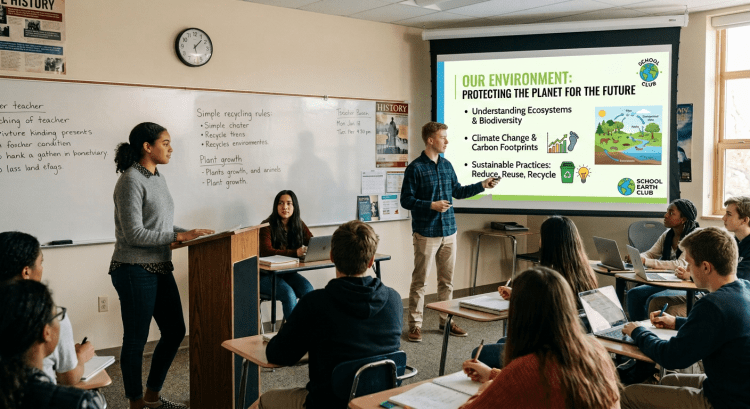
Modern college and corporate environments require people to build sharp visual presentations and deliver them with confidence. Crafting an effective slide deck and speaking publicly are arts that require structured training, constructive critique, and continuous practice.
5. Human Relationship Management
This isn’t about romance; it is about the core architecture of human connection. Students must learn how to actively listen, resolve conflicts, navigate group dynamics, and maintain healthy boundaries with family, teachers, neighbors, and coworkers.
The Problem with an Outdated Curriculum
It is unfortunate that our school systems rely heavily on decades-old historical data while ignoring current global shifts. Our country has progressed massively in science, commerce, and digital technology, yet these modern milestones rarely make it into standard textbooks.
Compounding this issue is the reality that higher education admissions—like engineering, medical, architecture, and IT courses—only calculate competitive marks from maths and science. Because of this structural bias, students sideline other vital subjects, treating a holistic education as a secondary afterthought.
Conclusion: Preparing for Life, Not Just Exams
True education should prepare a child for life, not just for a three-hour exam paper. It is time to reform our classrooms to value emotional intelligence, financial literacy, and communication just as much as geometry and chemistry.
What is the number one thing you wish schools taught you when you were younger? Do you agree that the Indian education system needs a major practical upgrade? Let’s start a conversation in the comments below!
Thank you, my dear readers, for stopping by today.
Stay happy, keep smiling, and have a beautiful, reflective Sunday!
Discover more from Awesomeplaces
Subscribe to get the latest posts sent to your email.

